Losselot
Audio forensics meets AI-assisted development - A living museum
View the Project on GitHub notactuallytreyanastasio/losselot
Audio Analysis: Finding Fake Lossless
Losselot uses dual analysis to detect transcodes: binary metadata inspection and FFT-based spectral analysis.
The Quick Version
Lossy codecs like MP3 remove high frequencies. This creates permanent scars:
| Source Quality | Typical Cutoff | What’s Missing |
|---|---|---|
| 128kbps MP3 | ~16kHz | Cymbals, air, sparkle |
| 192kbps MP3 | ~18kHz | Some high-end detail |
| 320kbps MP3 | ~20kHz | Only ultrasonic |
| True Lossless | ~22kHz | Nothing |
Converting an MP3 to FLAC doesn’t restore lost frequencies. The scars remain.
Spectral Analysis
The Spectrogram
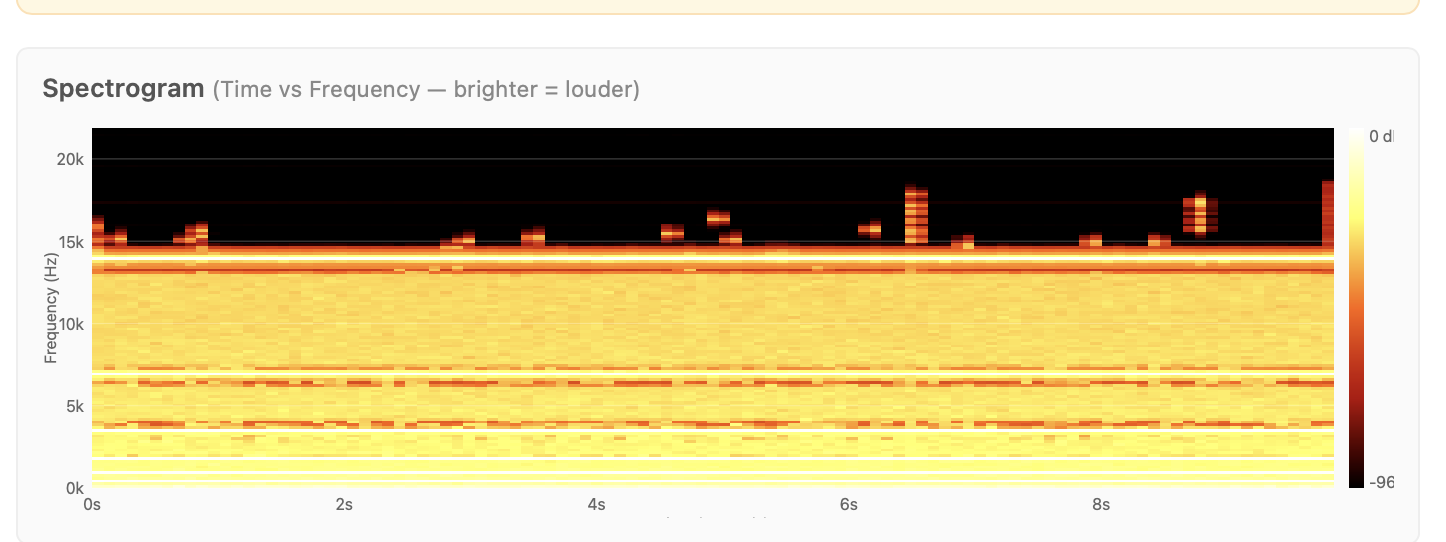
A spectrogram shows frequency (vertical) over time (horizontal). Brightness = energy.
What to look for:
- Horizontal cutoff lines - Where frequencies suddenly stop
- Dark bands at top - Missing high frequencies
- Consistent cutoff - Same frequency across entire track
The Frequency Response
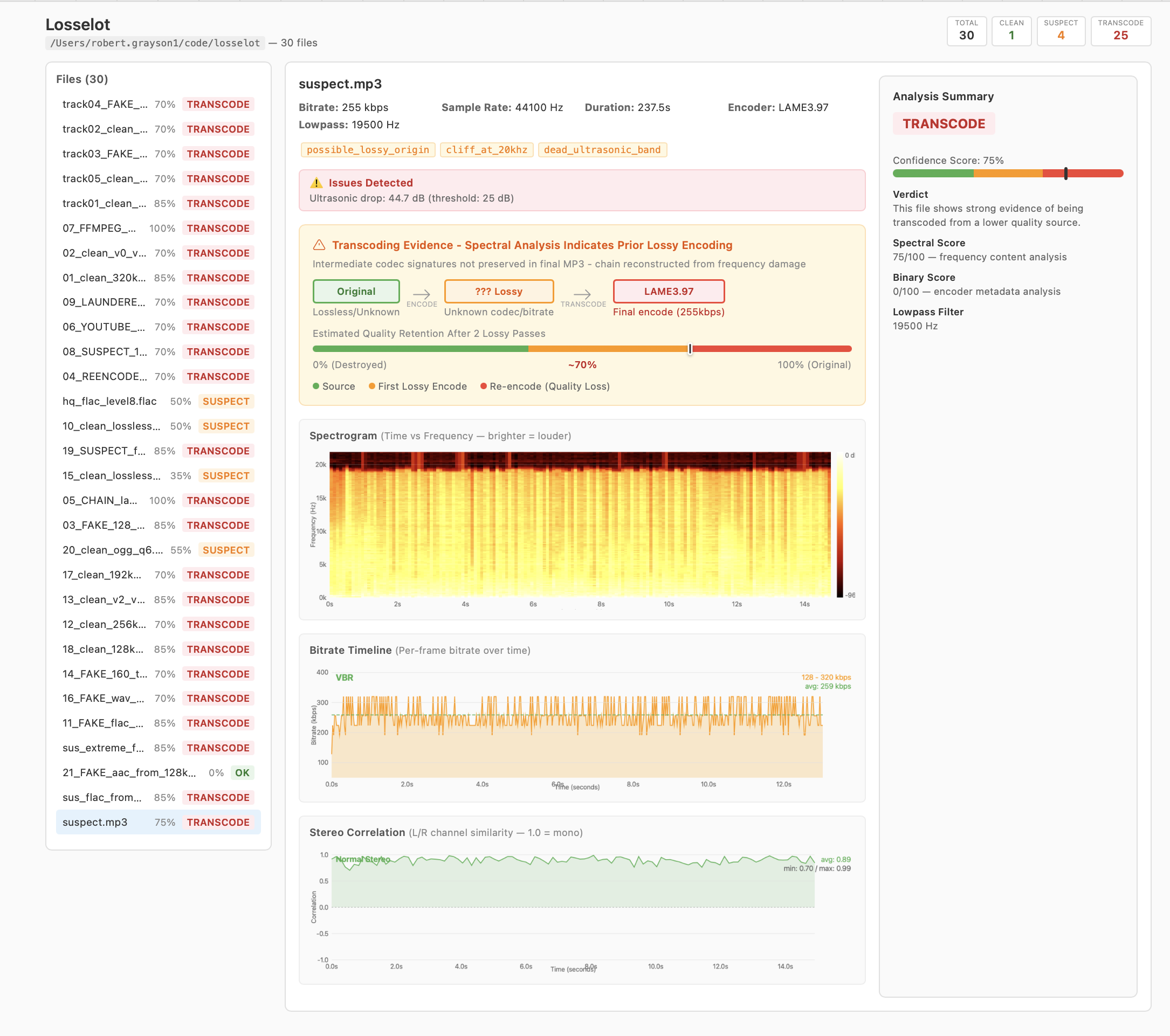
The frequency response curve shows exactly where audio cuts off. A sharp drop around 17-20kHz with steep rolloff is the telltale sign of lossy compression.
Binary Analysis (MP3)
For MP3 files, Losselot reads encoder metadata embedded in the file.
LAME Headers
The LAME encoder stores a “lowpass” value that reveals original encoding settings:
Header: LAME3.99r
Lowpass: 16000 Hz
Bitrate: 320 kbps

⚠️ MISMATCH: 320kbps should have ~20kHz lowpass
The smoking gun: A “320kbps” MP3 with a lowpass of 16kHz was definitely transcoded from a 128kbps source.
Re-encoding Detection
Multiple encoder signatures in one file indicate re-encoding:
Found: LAME3.99r (at offset 0x100)
Found: LAME3.100 (at offset 0x2a0)
Found: Lavf58.29.100 (at offset 0x340)

⚠️ ENCODING CHAIN: LAME → LAME → FFmpeg
Each lossy pass causes cumulative damage.
CFCC: Lo-Fi Detection
Not all high-frequency rolloff indicates lossy compression. Tape recordings and lo-fi productions have natural rolloff.
The Problem
MP3 @ 160kbps:          Tape Recording:
       |                        \
       |                         \
       |_____                     \___
      16kHz                      varies
   (brick wall)              (gradual rolloff)
Both have missing high frequencies - but for different reasons.
The Solution
Cross-Frequency Coherence Coefficient (CFCC) measures correlation between adjacent frequency bands:
- MP3: Sudden decorrelation at cutoff (cliff)
- Tape: Gradual decorrelation following dynamics
How It Works
- Divide spectrum into adjacent bands
- Measure correlation between each pair
- Look for sudden correlation drops
Band Pair    | Correlation | Change
-------------|-------------|--------
14-15 kHz    | 0.92        | -
15-16 kHz    | 0.89        | -0.03
16-17 kHz    | 0.31        | -0.58  ← CLIFF DETECTED
17-18 kHz    | 0.28        | -0.03
A correlation drop > 0.25 between adjacent bands signals a codec cliff.
Scoring
| Signal | Score Impact |
|---|---|
cfcc_cliff detected |
+25 |
decorrelation_spike |
+15 |
lofi_safe_natural_rolloff |
-15 |
The negative score for natural rolloff prevents false positives on legitimate lo-fi recordings.
Mixed-Source Detection
Some productions use both lossy and lossless sources:
22kHz  |    ██     ██  ██      |  ← Lossless elements
       |    ██     ██  ██      |
16kHz  |████████████████████████|  ← MP3 samples
       |████████████████████████|
0 Hz   |████████████████████████|
       0:00              4:00
The “pillars” of high-frequency content punching through indicate:
- Base track from MP3 samples
- Some elements (cymbals, synths) from lossless sources
This is not a fake - the file honestly contains what it contains. But it reveals the production used pre-lossy material.
Verdicts
| Verdict | Score | Meaning |
|---|---|---|
| CLEAN | 0-34 | Looks like genuine lossless |
| SUSPECT | 35-64 | Something’s off - investigate |
| TRANSCODE | 65-100 | Almost certainly from lossy source |
Detection Flags
Spectral Flags
severe_hf_damage- Major frequency losshf_cutoff_detected- Clear lossy cutoff patternweak_ultrasonic_content- Not enough content above 20kHzdead_ultrasonic_band- Virtually nothing above 20kHzsteep_hf_rolloff- Unnaturally sharp cutoffcfcc_cliff- CFCC detected codec clifflofi_safe_natural_rolloff- Natural rolloff (reduces score)
Re-encoding Flags
multi_encoder_sigs- Multiple encoders detectedencoding_chain(LAME → FFmpeg)- Specific chain identifiedlame_reencoded_x2- Double LAME encodinglowpass_bitrate_mismatch- Lowpass doesn’t match bitrate
Try It
# Analyze a single file
./losselot suspicious-file.flac

# Analyze a folder
./losselot ~/Music/

# Interactive web UI
./losselot serve ~/Music/ --port 3000

# Quick scan (binary only, no FFT)
./losselot --no-spectral ~/Music/
| ← Back to Home | Next: Decision Graph → |